
At-home laboratory test
Hair Elements
A laboratory measurement of 39 elements in a small hair sample, with 5 calculated ratios. Cut the sample at home, weigh it with the supplied scale and return it to Doctor's Data. Your written Health Map is included.
You want to know which minerals and metals are present in your hair, perhaps after possible contact with metals at work or through your surroundings. Hair Elements measures 39 elements, including zinc, magnesium, lead and mercury, and gives 5 calculated ratios between elements. You receive the laboratory report and a written Health Map that considers these measurements with your exposure history, questionnaire answers and other results you share. Hair values can be affected by hair products and external contamination and cannot establish body nutrient stores or diagnose metal poisoning.
Price includes delivery, prepaid sample return to the laboratory, laboratory analysis and your written Health Map report.
Pay by card or TWINT
- Sample
- Hair · 0.25 g
- Laboratory
- Doctor's Data · ICP-MS
- Laboratory turnaround
- About 10 days after laboratory receipt
Inside your sample report
Read the report before you order.
Follow the actual sample pages, with synthetic values. Your laboratory results come with a personalised written Health Map.
Open the full sample report (PDF) ↗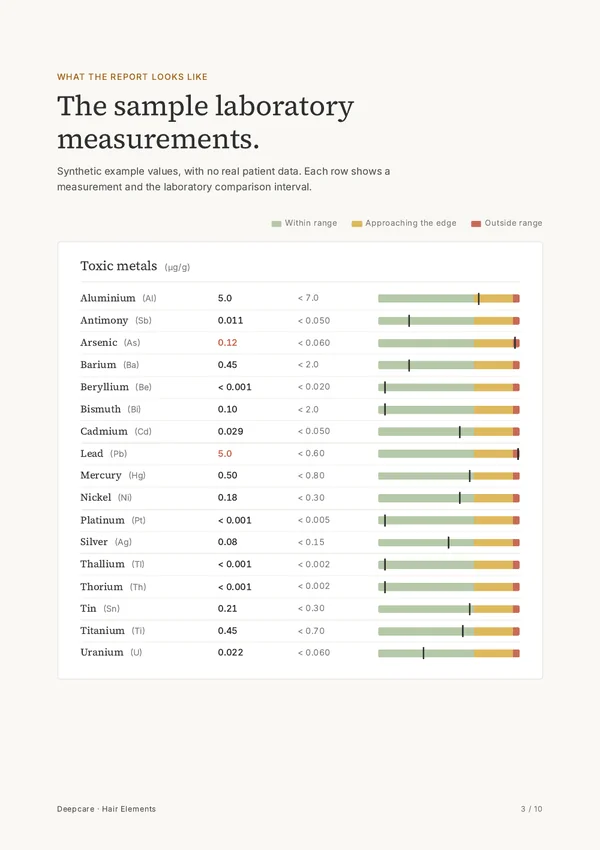
Section 01
The elements measured in your hair.
The first chart lists the laboratory's toxic-metal group. Each row pairs a concentration in micrograms per gram of hair with the laboratory reference interval. ICP-MS separates and measures elements by their mass. [1]
Section 02
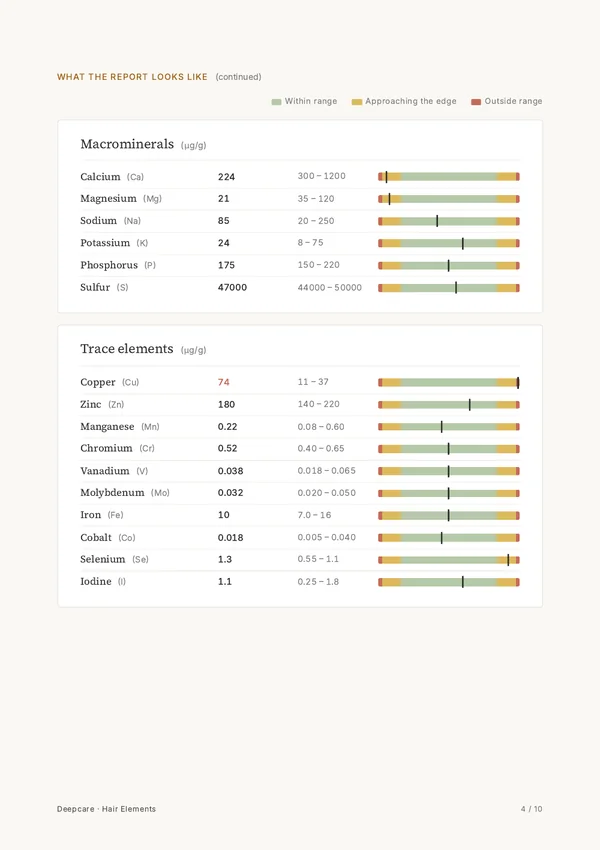
Minerals and trace elements.
Calcium, magnesium, sodium and the trace elements each have an individual row. The unit stays the same, so the concentration always refers to the hair sample submitted.
Section 03
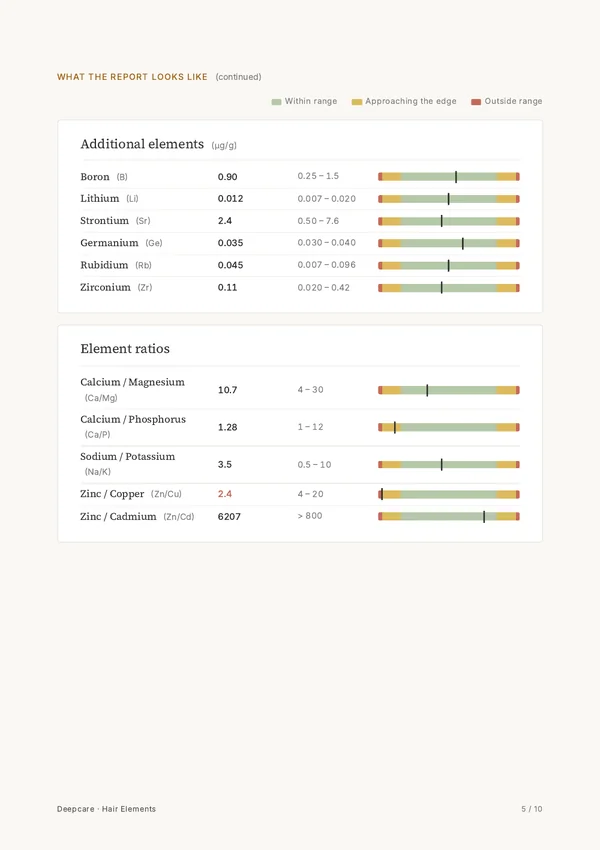
The calculated element ratios.
The report also gives calcium to magnesium, calcium to phosphorus, sodium to potassium, zinc to copper and zinc to cadmium. Each is calculated by dividing one measured hair concentration by the other.

Section 04
A written explanation with your context.
Your written Health Map brings the measurements together with the information you provide in questionnaires and by email. You can keep it with the laboratory report or share it with your GP.
The complete panel
What the laboratory measures.
Open a group to read each measurement. The groups follow the laboratory panel.
Toxic metals17
- Aluminium
- Aluminium enters the diet through foods such as tea and lentils, although the body absorbs only a small part of what is swallowed. [2]
- Antimony
- Antimony is used in flame-retardant materials and alloys, and many of its compounds are toxic. [3]
- Arsenic
- Inorganic arsenic in contaminated drinking water is an established human carcinogen and can also affect the skin and cardiovascular system. [4]
- Barium
- Soluble barium compounds are toxic and can disturb the nervous system and the heart's rhythm. [5]
- Beryllium
- Inhaling beryllium dust or fumes can trigger berylliosis, a persistent inflammatory lung disease associated with occupational exposure. [6]
- Bismuth
- Bismuth compounds are used in cosmetics and some stomach preparations, providing possible sources of contact with this metal. [7]
- Cadmium
- Cadmium can accumulate in the body, and inhalation of its fumes has caused illness in metal workers. [8]
- Lead
- Lead accumulates in bone and can harm brain development, with young children particularly vulnerable to its effects. [9]
- Mercury
- Methylmercury accumulates in fish and can affect the nervous system, particularly during fetal and early-childhood development. [10]
- Nickel
- Nickel is present in foods and metal objects, and direct skin contact can trigger allergy in sensitised people. [11]
- Platinum
- Platinum is used in pacemakers and other medical devices because of its resistance to corrosion. [12]
- Silver
- Long-term ingestion or inhalation of silver compounds can cause argyria, a grey-blue pigmentation of skin and mucous membranes. [13]
- Thallium
- Thallium can displace potassium in the body and affect the central nervous system. [14]
- Thorium
- Thorium is a naturally occurring radioactive metal whose radiation contributes to its toxicity. [15]
- Tin
- Tin is used to coat food cans, while the toxicity of organotin compounds differs from that of the metal itself. [16]
- Titanium
- Titanium bonds well with bone and is used in joint replacements and dental implants. [17]
- Uranium
- Uranium is a radioactive metal occurring naturally in rocks and minerals, including deposits from which it can enter the environment. [18]
Macrominerals6
- Calcium
- Calcium gives bones and teeth their mineral structure and also participates in muscle contraction and nerve signalling. [19]
- Magnesium
- Magnesium helps enzymes carry out reactions that release energy from food and keep nerves and muscles working normally. [19]
- Sodium
- Sodium is the main positively charged ion outside cells and helps maintain fluid distribution and nerve impulses. [19]
- Potassium
- Potassium is concentrated inside cells and helps establish the electrical gradients needed for muscle and nerve activity. [19]
- Phosphorus
- Phosphorus forms part of bone mineral, cell membranes and ATP, the molecule used to transfer energy within cells. [19]
- Sulfur
- Sulfur is incorporated into protein-building amino acids and some coenzymes used in metabolism. [20]
Trace minerals10
- Copper
- Copper supports enzymes involved in iron handling, connective-tissue formation and cellular energy production. [19]
- Zinc
- Zinc contributes to enzyme function, DNA and protein synthesis, and normal immune-cell activity. [19]
- Manganese
- Manganese helps an enzyme called manganese superoxide dismutase neutralise reactive oxygen compounds that can damage cells. [21]
- Chromium
- Chromium occurs in food mainly in its trivalent form, chemically distinct from toxic hexavalent chromium produced by some industrial processes. [22]
- Vanadium
- Vanadium is a trace metal used in tough steel alloys, and some of its compounds can be toxic. [23]
- Molybdenum
- Molybdenum helps enzymes break down sulfur-containing protein building blocks and purines, components of DNA and other cell molecules. [24]
- Iron
- Iron in haemoglobin carries oxygen in the blood, while iron-containing enzymes also participate in cellular energy metabolism. [19]
- Cobalt
- Cobalt sits at the centre of vitamin B12, which is why this metal has a nutritional role in the body. [25]
- Selenium
- Selenium is incorporated into proteins involved in antioxidant defence and thyroid hormone metabolism. [19]
- Iodine
- Iodine is built into thyroid hormones, which regulate metabolism and contribute to growth and development. [19]
Additional elements6
- Boron
- Boron is supplied mainly by plant foods, including fruit, legumes and nuts, and is absorbed from the digestive tract. [26]
- Lithium
- Lithium occurs naturally in minerals such as spodumene and petalite; this panel reports the elemental concentration in hair. [27]
- Strontium
- Strontium resembles calcium chemically and can become incorporated into bone. [28]
- Germanium
- Germanium is a metalloid used in optical glass and semiconductor technology, with its hair concentration reported here as an elemental measurement. [29]
- Rubidium
- Rubidium is chemically similar to potassium and is absorbed from food into the body. [30]
- Zirconium
- Zirconium is a corrosion-resistant metal used in industry, and this entry measures its concentration in the submitted hair. [31]
Element ratios5
- Calcium / Magnesium
- The calcium-to-magnesium ratio divides the measured calcium concentration in hair by the magnesium concentration.
- Calcium / Phosphorus
- Calcium relative to phosphorus is calculated from the concentrations of these two elements in the same hair sample.
- Sodium / Potassium
- This result expresses how much sodium was measured in hair relative to potassium, using the laboratory's concentration units.
- Zinc / Copper
- The zinc/copper calculation places the hair zinc result over the copper result as a dimensionless quotient.
- Zinc / Cadmium
- Dividing hair zinc by hair cadmium gives the reported comparison between those two measured elements.
Scientific references
- Elemental hair analysis: A review of procedures and applications. Pozebon D, Scheffler GL, Dressler VL., 2017. DOI: 10.1016/j.aca.2017.09.017. PMID: 29054142.
- Aluminium - Element information, properties and uses. Royal Society of Chemistry, accessed 2026.
- Antimony - Element information, properties and uses. Royal Society of Chemistry, accessed 2026.
- Arsenic. World Health Organization, accessed 2026.
- Barium - Element information, properties and uses. Royal Society of Chemistry, accessed 2026.
- Beryllium - Element information, properties and uses. Royal Society of Chemistry, accessed 2026.
- Bismuth - Element information, properties and uses. Royal Society of Chemistry, accessed 2026.
- Cadmium - Element information, properties and uses. Royal Society of Chemistry, accessed 2026.
- Lead poisoning. World Health Organization, accessed 2026.
- Mercury. World Health Organization, accessed 2026.
- Nickel - Element information, properties and uses. Royal Society of Chemistry, accessed 2026.
- Platinum - Element information, properties and uses. Royal Society of Chemistry, accessed 2026.
- Silver - Element information, properties and uses. Royal Society of Chemistry, accessed 2026.
- Thallium - Element information, properties and uses. Royal Society of Chemistry, accessed 2026.
- Thorium - Element information, properties and uses. Royal Society of Chemistry, accessed 2026.
- Tin - Element information, properties and uses. Royal Society of Chemistry, accessed 2026.
- Titanium - Element information, properties and uses. Royal Society of Chemistry, accessed 2026.
- Uranium - Element information, properties and uses. Royal Society of Chemistry, accessed 2026.
- Biochemistry, Nutrients. Morris AL, Mohiuddin SS., 2023. PMID: 32119432.
- Sulfur - Element information, properties and uses. Royal Society of Chemistry, accessed 2026.
- Manganese - Health Professional Fact Sheet. NIH Office of Dietary Supplements, accessed 2026.
- Chromium - Health Professional Fact Sheet. NIH Office of Dietary Supplements, accessed 2026.
- Vanadium - Element information, properties and uses. Royal Society of Chemistry, accessed 2026.
- Molybdenum - Health Professional Fact Sheet. NIH Office of Dietary Supplements, accessed 2026.
- Cobalt - Element information, properties and uses. Royal Society of Chemistry, accessed 2026.
- Boron - Health Professional Fact Sheet. NIH Office of Dietary Supplements, accessed 2026.
- Lithium - Element information, properties and uses. Royal Society of Chemistry, accessed 2026.
- Strontium - Element information, properties and uses. Royal Society of Chemistry, accessed 2026.
- Germanium - Element information, properties and uses. Royal Society of Chemistry, accessed 2026.
- Rubidium - Element information, properties and uses. Royal Society of Chemistry, accessed 2026.
- Zirconium - Element information, properties and uses. Royal Society of Chemistry, accessed 2026.
Included in the price
Your kit and your written Health Map.
Delivery to Switzerland, Liechtenstein and every EU country in 2 to 3 working days. Sample return is included.
The kit arrives in the laboratory's packaging. Product pictures are illustrations.
CHF 219
Price includes delivery, prepaid sample return to the laboratory, laboratory analysis and your written Health Map report.
Pay by card or TWINT
Your written Health Map report
The kit price includes a systematic written evaluation for each person tested. We consider all of that person's kit results together with their questionnaire answers and any other results they share. After payment, your first personalised questionnaire arrives by email. Your answers, laboratory results and email exchanges form the basis of the report. Follow-up questions arrive by email or a further questionnaire when needed. The final report is written in your language, English, French or German, within 3 working days of your answers to the last questionnaire.
Read about the Health Map ↗Questions about this kit
How much hair is needed?
About 0.25 g. The kit includes a small scale and collection instructions for taking the section closest to the scalp.
What does ICP-MS mean?
Inductively coupled plasma mass spectrometry. The laboratory uses it to quantify elements in the prepared hair sample.