
At-home laboratory test
Omega-3 + Vitamin D
A finger-prick blood sample for your fatty-acid profile and vitamin D. Collect a dried bloodspot at home and send it to the laboratory in the supplied return packaging. Your written Health Map is included.
You eat little oily fish, take vitamin D or omega-3 supplements, or want to check your levels before changing your intake. From a finger-prick blood sample, the laboratory measures your omega-3 index, the proportion of EPA and DHA omega-3 fats in red blood cells, together with your wider fatty-acid profile and vitamin D level. You receive the laboratory report and a written Health Map that considers the measurements with your diet, supplements, questionnaire answers and other results you share. The kit cannot explain fatigue on its own or assess every nutrient.
Price includes delivery, prepaid sample return to the laboratory, laboratory analysis and your written Health Map report.
Pay by card or TWINT
- Sample
- Dried bloodspot
- Laboratory
- OmegaQuant
- Laboratory turnaround
- About 21 days (±5) after laboratory receipt
Inside your sample report
Read the report before you order.
Follow the actual sample pages, with synthetic values. Your laboratory results come with a personalised written Health Map.
Open the full sample report (PDF) ↗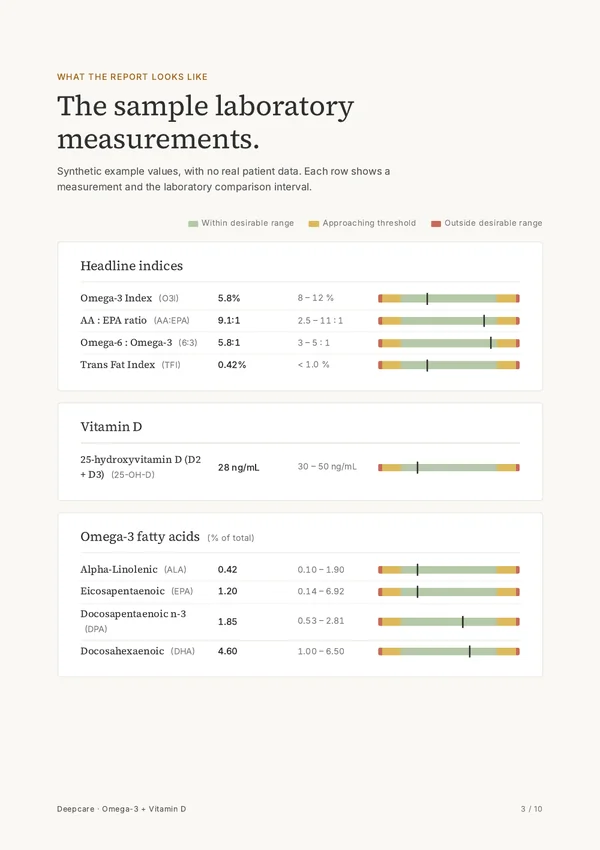
Section 01
Omega-3 Index and vitamin D
The opening results bring the Omega-3 Index, trans-fat index and fatty-acid ratios beside the vitamin D measurement. The Omega-3 Index is EPA plus DHA as a percentage of red blood cell fatty acids. It describes longer-term EPA and DHA status. [1]
Section 02
Omega-6 fatty acids
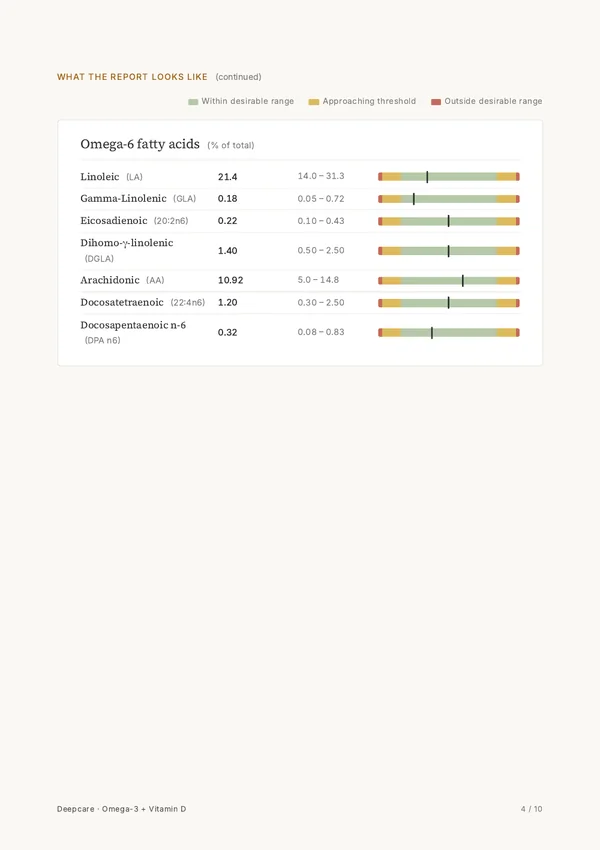
Linoleic acid, arachidonic acid and the other omega-6 fatty acids each have a separate percentage. The notation identifies the molecule: 20:4 for arachidonic acid describes 20 carbon atoms and 4 double bonds.
Section 03
The rest of the fatty-acid profile.
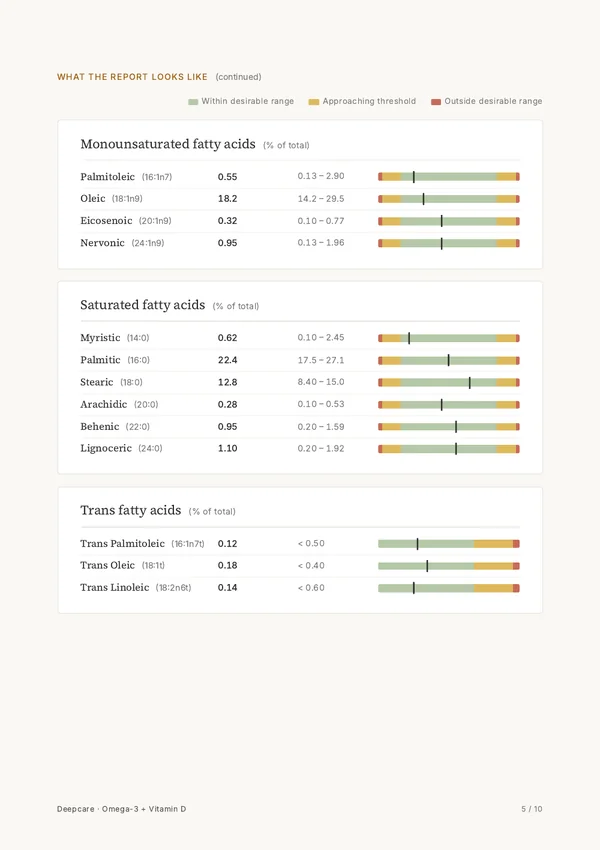
The remaining families sit together so you can read the individual percentages alongside the combined indices. Saturated, monounsaturated and trans fatty acids each have a separate laboratory entry.

Section 04
Your results in a written Health Map.
Your questionnaire answers and email exchanges give context to the laboratory measurements. Your Health Map report is included in the CHF 149 price, with follow-up questions when needed.
The complete panel
What the laboratory measures.
Open a group to read each measurement. The groups follow the laboratory panel.
Omega-3 fatty acids5
- Omega-3 Index (RBC)
- The Omega-3 Index is the proportion of EPA plus DHA in red-cell fatty acids, reflecting longer-term intake of these marine omega-3 fats. [1]
- Alpha-Linolenic (ALA, 18:3n3)
- Alpha-linolenic acid is an essential omega-3 fat supplied by plant foods such as flaxseed, walnuts and rapeseed oil. [2]
- Eicosapentaenoic (EPA, 20:5n3)
- EPA is a long-chain omega-3 fat that the body uses to make eicosanoids, signalling molecules involved in cellular responses. [3]
- Docosapentaenoic (DPA n-3, 22:5n3)
- Omega-3 DPA is an elongated product of EPA and an intermediate in the biochemical pathway connecting EPA with DHA. [4]
- Docosahexaenoic (DHA, 22:6n3)
- DHA is concentrated in the retina and brain, where it forms part of the membranes surrounding cells. [2]
Omega-6 fatty acids7
- Linoleic (LA, 18:2n6)
- Linoleic acid is an essential omega-6 fat needed for the skin's barrier against water loss. [3]
- Gamma-Linolenic (GLA, 18:3n6)
- Gamma-linolenic acid is made from linoleic acid as the body converts this dietary fat into longer omega-6 fats used in cell membranes and signalling. [5]
- Eicosadienoic (20:2n6)
- Eicosadienoic acid is an omega-6 fatty acid with 20 carbon atoms and two double bonds, measured here as a share of the fatty-acid profile.
- Dihomo-γ-linolenic (DGLA, 20:3n6)
- DGLA is an omega-6 fat used to make prostaglandins, local chemical messengers through which cells influence nearby tissues. [3]
- Arachidonic (AA, 20:4n6)
- Arachidonic acid is stored in the fats that form cell membranes and can be released to make chemical messengers involved in inflammation and other local responses. [5]
- Docosatetraenoic (22:4n6)
- Docosatetraenoic acid, also called adrenic acid, is a 22-carbon omega-6 fat incorporated into the lipids that form cell membranes. [6]
- Docosapentaenoic (DPA n-6, 22:5n6)
- Omega-6 DPA is a very-long-chain polyunsaturated fatty acid in the metabolic family derived from dietary linoleic acid. [7]
Monounsaturated fatty acids4
- Palmitoleic (16:1n7)
- Palmitoleic acid is made from palmitic acid by an enzyme that changes a bond in the molecule, producing a fat with one double bond. [8]
- Oleic (18:1n9)
- Oleic acid comes from food or is made from stearic acid and becomes part of stored body fat and the fats that form cell membranes. [8]
- Eicosenoic (20:1n9)
- Eicosenoic acid, also called gondoic acid, is a 20-carbon omega-9 fat that enzymes can alter by adding another double bond to its carbon chain. [6]
- Nervonic (24:1n9)
- Nervonic acid is part of the fats in myelin, the insulating sheath around nerve fibres. [6]
Saturated fatty acids6
- Myristic (14:0)
- Myristic acid is a 14-carbon saturated fat supplied by dairy fat, where it is one of the more abundant fatty acids. [9]
- Palmitic (16:0)
- Palmitic acid is the main fatty acid the body makes from scratch and is also a starting material for building longer fats. [6]
- Stearic (18:0)
- Stearic acid is an 18-carbon saturated fat that the body can convert to oleic acid by creating a double bond in its carbon chain. [8]
- Arachidic (20:0)
- Arachidic acid is a 20-carbon saturated fatty acid found in small amounts in dairy fat. [9]
- Behenic (22:0)
- Behenic acid is a 22-carbon saturated fat incorporated into sphingomyelin, one of the fats that help form cell membranes. [6]
- Lignoceric (24:0)
- Lignoceric acid supplies 24-carbon chains to sphingolipids, a family of fats found in cell membranes, including those in the nervous system. [6]
Trans fatty acids3
- Trans Palmitoleic (16:1n7t)
- Trans-palmitoleic acid is a 16-carbon trans fat present in ruminant milk fat and therefore in dairy foods. [9]
- Trans Oleic (18:1t)
- Trans-octadecenoic fatty acids have one trans double bond, with several positional isomers occurring in milk fat. [9]
- Trans Linoleic (18:2n6t)
- Trans-linoleic fatty acids contain two double bonds with at least one in the trans configuration and occur in small amounts in dairy fat. [9]
Vitamin D1
- 25-hydroxyvitamin D (D2 + D3)
- 25-hydroxyvitamin D is the main circulating form used to assess vitamin D status, while vitamin D supports intestinal calcium absorption and bone mineralisation. [10]
Derived indices4
- Omega-3 Index
- Adding the EPA and DHA percentages in red-cell fatty acids produces the summary Omega-3 Index shown with the profile's calculated results. [1]
- Trans Fat Index
- The Trans Fat Index adds the laboratory's measured trans-fatty-acid percentages into one summary value.
- AA : EPA ratio
- The AA:EPA ratio expresses measured arachidonic acid relative to eicosapentaenoic acid in the fatty-acid profile.
- Omega-6 : Omega-3 ratio
- This calculation compares the summed measured omega-6 fatty acids with the summed omega-3 fatty acids.
Scientific references
- The Omega-3 Index: a new risk factor for death from coronary heart disease?. Harris WS, Von Schacky C., 2004. DOI: 10.1016/j.ypmed.2004.02.030. PMID: 15208005.
- Omega-3 Fatty Acids - Health Professional Fact Sheet. NIH Office of Dietary Supplements, accessed 2026.
- The essential fatty acids. Sardesai VM., 1992. DOI: 10.1177/0115426592007004179. PMID: 1294887.
- Docosapentaenoic acid (22:5n-3): a review of its biological effects. Kaur G, Cameron-Smith D, Garg M, Sinclair AJ., 2011. DOI: 10.1016/j.plipres.2010.07.004. PMID: 20655949.
- Roles of polyunsaturated fatty acids, from mediators to membranes. Harayama T, Shimizu T., 2020. DOI: 10.1194/jlr.r120000800. PMID: 32487545.
- Review of Eukaryote Cellular Membrane Lipid Composition, with Special Attention to the Fatty Acids. Ali O, Szabó A., 2023. DOI: 10.3390/ijms242115693. PMID: 37958678.
- Metabolism of very long-chain Fatty acids: genes and pathophysiology. Sassa T, Kihara A., 2014. DOI: 10.4062/biomolther.2014.017. PMID: 24753812.
- Biochemical and physiological function of stearoyl-CoA desaturase. Paton CM, Ntambi JM., 2009. DOI: 10.1152/ajpendo.90897.2008. PMID: 19066317.
- Fatty acids in bovine milk fat. Månsson HL., 2008. DOI: 10.3402/fnr.v52i0.1821. PMID: 19109654.
- Vitamin D - Health Professional Fact Sheet. NIH Office of Dietary Supplements, accessed 2026.
- Vitamin D assays and the definition of hypovitaminosis D: results from the First International Conference on Controversies in Vitamin D. Sempos CT, Heijboer AC, Bikle DD, Bollerslev J, Bouillon R, Brannon PM, DeLuca HF, Jones G, Munns CF, Bilezikian JP, Giustina A, Binkley N., 2018. DOI: 10.1111/bcp.13652. PMID: 29851137.
Included in the price
Your kit and your written Health Map.
Delivery to Switzerland, Liechtenstein and every EU country in 2 to 3 working days. Sample return is included.
The kit arrives in the laboratory's packaging. Product pictures are illustrations.
CHF 149
Price includes delivery, prepaid sample return to the laboratory, laboratory analysis and your written Health Map report.
Pay by card or TWINT
Your written Health Map report
The kit price includes a systematic written evaluation for each person tested. We consider all of that person's kit results together with their questionnaire answers and any other results they share. After payment, your first personalised questionnaire arrives by email. Your answers, laboratory results and email exchanges form the basis of the report. Follow-up questions arrive by email or a further questionnaire when needed. The final report is written in your language, English, French or German, within 3 working days of your answers to the last questionnaire.
Read about the Health Map ↗Questions about this kit
How is the sample collected?
Use the supplied finger-prick materials to place drops on the bloodspot card. Let it dry and return it as the kit instructions specify.
What does the vitamin D result measure?
The panel measures total 25-hydroxyvitamin D, the sum of D2 and D3 forms. This is the circulating marker used to assess vitamin D status.