
At-home laboratory test
Organic Acids Test (OAT)
A urine profile of metabolic byproducts from Mosaic Diagnostics. It covers 76 report markers, including two calculated ratios, plus urine creatinine. Collection at home and your written Health Map are included.
You may be looking into persistent tiredness or have questions about vitamin intake and gut microbes. The Organic Acids Test (OAT) measures urine compounds linked to yeast and bacteria, energy metabolism and the breakdown of neurotransmitters, chemical messengers such as dopamine. The report also covers vitamin-related markers, including compounds linked to B6 and B12, and oxalates such as oxalic acid. You receive the laboratory report and a written Health Map that reads these measurements with your questionnaire answers, supplement use and any other results you share. The test cannot diagnose disease or a deficiency, or measure neurotransmitter levels in the brain.
Price includes delivery, prepaid sample return to the laboratory, laboratory analysis and your written Health Map report.
Pay by card or TWINT
- Sample
- First-morning urine, at least 10 mL
- Laboratory
- Mosaic Diagnostics · GC-MS
- Laboratory turnaround
- About 21 days after laboratory receipt
Inside your sample report
Read the report before you order.
Follow the actual sample pages, with synthetic values. Your laboratory results come with a personalised written Health Map.
Open the full sample report (PDF) ↗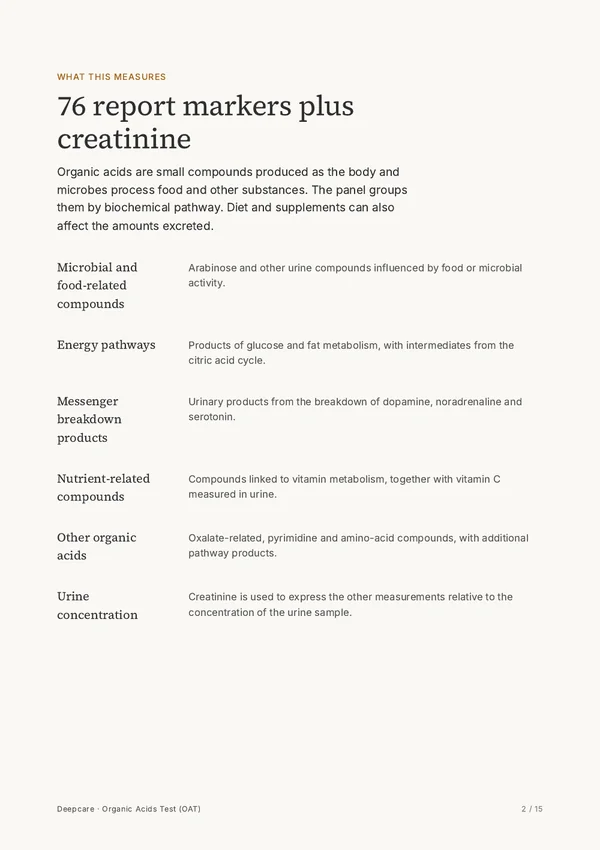
Section 01
The urine compounds in this panel.
Organic acids are small compounds produced as the body and microbes process food and other substances. The panel groups them by biochemical pathway. Diet and supplements can also affect the amounts excreted.
Section 02
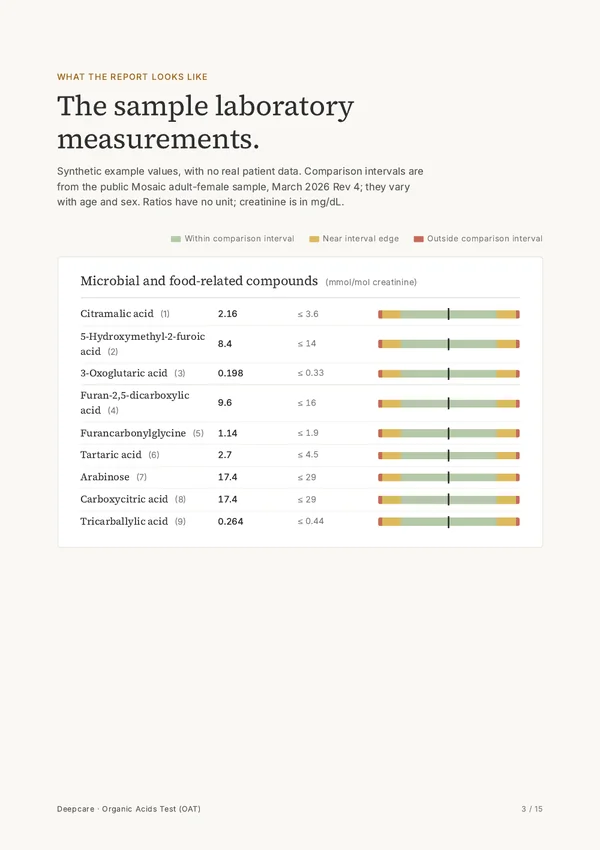
Microbial and dietary compounds.
This group includes arabinose, tartaric acid and other compounds associated with microbial activity or food intake. A urine value cannot count gut organisms or establish an infection. GI MAP examines different targets in stool. [1]
Section 03
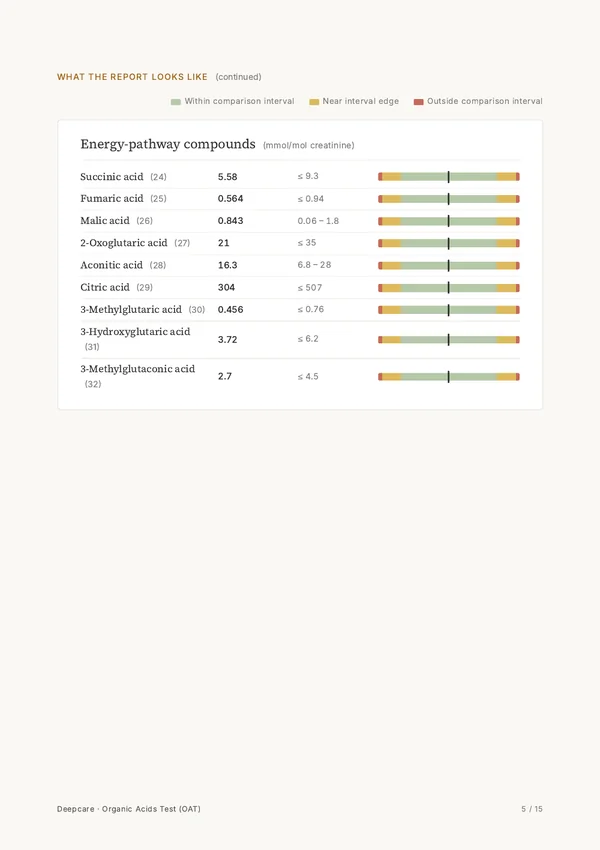
Products of energy pathways.
The report lists citric acid, succinic acid and other compounds grouped under energy pathways. These are urine measurements of metabolic products. They do not measure how much energy your cells produce or explain fatigue on their own. [1]
Section 04
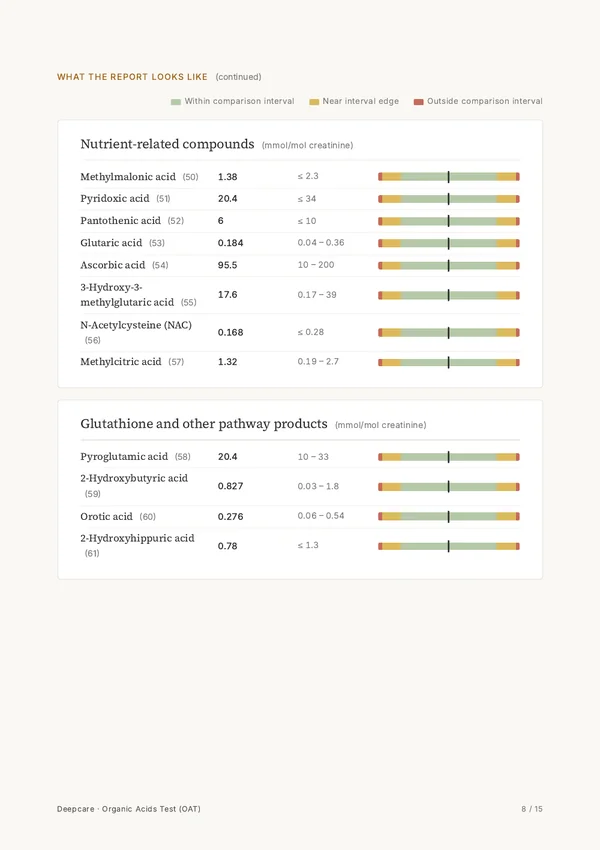
Nutrient-related measurements and their limits.
Methylmalonic acid, pyridoxic acid and other nutrient-related compounds appear separately. These values depend on several influences and cannot diagnose a nutrient deficiency. Your Health Map considers the questionnaire, supplement use and other results.
Section 05
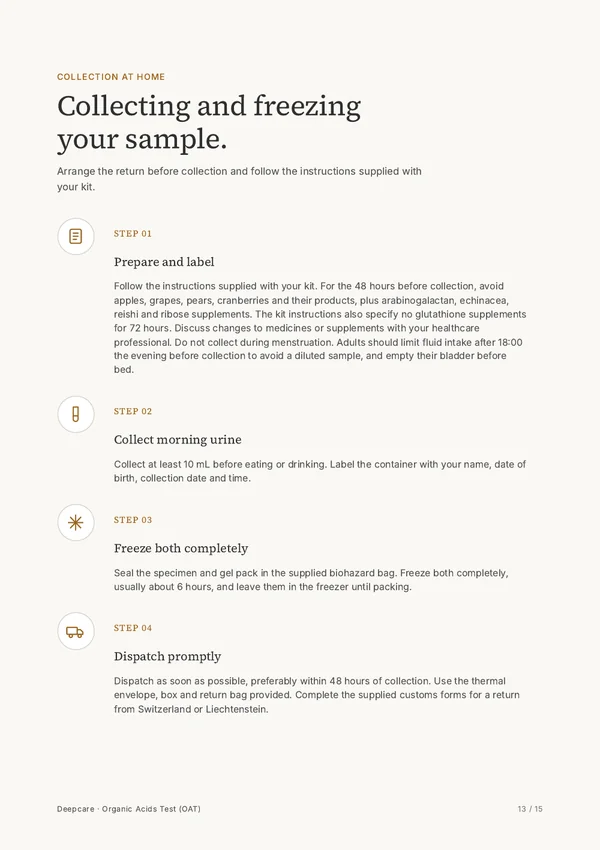
Collecting and freezing your sample.
Collect at least 10 mL of first-morning urine before eating or drinking. Freeze the sealed specimen and gel pack completely, usually about 6 hours, and keep them frozen until packing. Dispatch as soon as possible, preferably within 48 hours of collection, in the supplied thermal envelope and return box.
The complete panel
What the laboratory measures.
Open a group to read each measurement. The groups follow the laboratory panel.
Microbial and food-related compounds18
- Citramalic acid
- Citramalic acid is related to malic acid and occurs in plants and yeast as well as in human metabolism. [2]
- 5-Hydroxymethyl-2-furoic acid
- 5-Hydroxymethyl-2-furoic acid is a ring-shaped organic acid produced by some fungi and found in human urine. [3]
- 3-Oxoglutaric acid
- 3-Oxoglutaric acid, also called acetonedicarboxylic acid, has a five-carbon chain with an oxygen atom attached at its centre. [4]
- Furan-2,5-dicarboxylic acid
- Furan-2,5-dicarboxylic acid is a small ring-shaped molecule with two acid groups, also found among human urinary metabolites. [5]
- Furancarbonylglycine
- Furancarbonylglycine combines furoic acid with glycine, a building block of proteins. [6]
- Tartaric acid
- Tartaric acid is a naturally occurring fruit acid found particularly in grapes, so food can contribute to its urinary level. [7]
- Arabinose
- Arabinose is a sugar found in plants and also used or produced by microorganisms such as yeast. [8]
- Carboxycitric acid
- Carboxycitric acid resembles citric acid but has an additional acid group, giving it four acid groups in total. [9]
- Tricarballylic acid
- Tricarballylic acid has a three-carbon backbone carrying three acid groups; it is chemically distinct from citric acid. [10]
- Hippuric acid
- Hippuric acid forms when benzoic acid combines with glycine, helping the body excrete compounds that can originate in food. [11]
- 2-Hydroxyphenylacetic acid
- 2-Hydroxyphenylacetic acid is a product of the metabolism of phenylalanine, a building block of proteins. [12]
- 4-Hydroxybenzoic acid
- 4-Hydroxybenzoic acid is a plant compound related to benzoic acid and is also produced by some bacteria and yeast. [13]
- 4-Hydroxyhippuric acid
- 4-Hydroxyhippuric acid combines a hydroxybenzoic acid molecule with glycine, a building block of proteins. [14]
- DHPPA
- DHPPA, also called dihydrocaffeic acid, is formed from caffeic acid, a compound found in plants. [15]
- 4-Hydroxyphenylacetic acid
- 4-Hydroxyphenylacetic acid is a urinary product of the metabolism of tyrosine, a building block of proteins. [16]
- HPHPA
- HPHPA is a urinary compound associated with bacterial processing of phenylalanine, a building block of proteins; its origin is not specific to one organism. [17]
- 4-Cresol
- 4-Cresol is a phenol that gut bacteria can produce when they break down certain building blocks of proteins. [18]
- 3-Indoleacetic acid
- 3-Indoleacetic acid can form when gut bacteria break down tryptophan, a building block of proteins; human tissues can also produce it. [19]
Oxalate-related compounds3
- Glyceric acid
- Glyceric acid can form through oxidation, a chemical transformation of glycerol. [20]
- Glycolic acid
- Glycolic acid is the smallest member of the alpha-hydroxy acids, with two carbon atoms and an oxygen-containing group beside its acid group. [21]
- Oxalic acid
- Oxalic acid occurs in foods such as spinach and is also made in the body from other compounds, including vitamin C, before urinary excretion. [22]
Products of glucose metabolism2
- Lactic acid
- Lactic acid is produced during sugar metabolism and can be converted back to pyruvic acid. [23]
Energy-pathway compounds9
- Succinic acid
- Succinic acid participates in the citric acid cycle, a series of reactions cells use to release energy, where it is converted to fumaric acid. [26][25]
- Fumaric acid
- Fumaric acid forms from succinic acid and is converted to malic acid during the citric acid cycle, part of cellular energy metabolism. [27][25]
- Malic acid
- Malic acid is converted to oxaloacetic acid during the citric acid cycle, a series of reactions involved in releasing energy in cells. [28][25]
- 2-Oxoglutaric acid
- 2-Oxoglutaric acid participates in the citric acid cycle and also links energy metabolism with the processing of protein building blocks. [29][25]
- Aconitic acid
- Aconitic acid has a form called cis-aconitate, which is produced as cells convert citrate to isocitrate in the citric acid cycle. [30][31]
- Citric acid
- Citric acid is found in citrus fruits and also participates in the cellular reactions named the citric acid cycle. [32][25]
- 3-Methylglutaric acid
- 3-Methylglutaric acid is a branched form of glutaric acid, with a small carbon side chain attached to its central carbon atom. [33]
- 3-Hydroxyglutaric acid
- 3-Hydroxyglutaric acid is related to glutaric acid and carries an additional oxygen-containing group on its central carbon atom. [34]
- 3-Methylglutaconic acid
- 3-Methylglutaconic acid is linked to a step in the breakdown of leucine, a building block of proteins. [35]
Messenger breakdown and tryptophan products8
- Homovanillic acid (HVA)
- Homovanillic acid (HVA) is a major end product of dopamine breakdown excreted in urine; the result does not measure dopamine in the brain. [36]
- Vanillylmandelic acid (VMA)
- Vanillylmandelic acid (VMA) forms during the breakdown of the messenger substances noradrenaline and adrenaline before urinary excretion. [36]
- HVA/VMA ratio
- The HVA/VMA ratio divides urinary homovanillic acid by vanillylmandelic acid; it compares dopamine breakdown with adrenaline and noradrenaline breakdown without measuring brain levels. [1][36]
- Dihydroxyphenylacetic acid (DOPAC)
- DOPAC forms when dopamine is broken down and is chemically related to HVA, another urinary product of the same process. [37]
- HVA/DOPAC ratio
- The HVA/DOPAC ratio divides HVA by DOPAC, comparing two products of dopamine breakdown; the calculated value has no unit. [1]
- 5-Hydroxyindoleacetic acid (5-HIAA)
- 5-HIAA forms when the liver breaks down serotonin, a chemical messenger, and is then excreted in urine; it does not measure brain serotonin. [38]
- Quinolinic acid
- Quinolinic acid is a step in converting tryptophan, a building block of proteins, into NAD, a molecule cells use to release energy from food. [39][40]
- Kynurenic acid
- Kynurenic acid is made from kynurenine, a product of the breakdown of the protein building block tryptophan, by enzymes that use vitamin B6. [41]
Pyrimidine compounds2
Ketones and fatty-acid products7
- 3-Hydroxybutyric acid
- 3-Hydroxybutyric acid is a ketone body made in the liver that can supply energy to the brain during fasting. [44]
- Acetoacetic acid
- Acetoacetic acid is another ketone body, chemically distinct from 3-hydroxybutyric acid, that the body can use as fuel. [45]
- Ethylmalonic acid
- Ethylmalonic acid is a small fatty-acid-related molecule with two acid groups and an attached two-carbon side chain. [46]
- Methylsuccinic acid
- Methylsuccinic acid resembles succinic acid but has an additional one-carbon branch, making it a different molecule. [47]
- Adipic acid
- Adipic acid is a six-carbon fatty acid with an acid group at each end of its chain; it is also used to regulate acidity in foods. [48]
- Suberic acid
- Suberic acid is an eight-carbon fatty acid with an acid group at each end, two carbons longer than adipic acid. [49]
- Sebacic acid
- Sebacic acid is a ten-carbon fatty acid with an acid group at each end, normally present among the acids excreted in urine. [50]
Nutrient-related compounds8
- Methylmalonic acid
- Methylmalonic acid is linked to a reaction that needs vitamin B12 to process propionate, a short-chain fatty acid. [51]
- Pyridoxic acid
- Pyridoxic acid forms as the body breaks down vitamin B6 and is then excreted in urine. [52]
- Pantothenic acid
- Pantothenic acid is vitamin B5, which cells use to make coenzyme A, a molecule involved in processing fats and other food components. [53]
- Glutaric acid
- Glutaric acid is linked to the breakdown of lysine and tryptophan, two building blocks of proteins. [54]
- Ascorbic acid
- Ascorbic acid is vitamin C, which helps protect cells against oxidation and is needed to form collagen in connective tissues. [55]
- 3-Hydroxy-3-methylglutaric acid
- 3-Hydroxy-3-methylglutaric acid is linked to reactions involved in leucine breakdown and ketone formation; a urine value does not establish a need for coenzyme Q10. [56]
- N-Acetylcysteine (NAC)
- N-acetylcysteine (NAC) is a modified form of cysteine, a protein building block used to make the cell-protecting molecule glutathione. [57]
- Methylcitric acid
- Methylcitric acid is related to citric acid but carries an additional one-carbon branch; it occurs in both human and bacterial metabolism. [58]
Glutathione and other pathway products4
- Pyroglutamic acid
- Pyroglutamic acid participates in the cycle that makes and breaks down glutathione, a molecule that helps protect cells against reactive oxygen compounds. [59]
- 2-Hydroxybutyric acid
- 2-Hydroxybutyric acid is a four-carbon organic acid whose urinary excretion can increase after alcohol intake or vigorous exercise. [60]
- Orotic acid
- Orotic acid is an intermediate in making pyrimidines, the family of building blocks that includes uracil in RNA and thymine in DNA. [61]
- 2-Hydroxyhippuric acid
- 2-Hydroxyhippuric acid, also called salicyluric acid, combines salicylic acid with the protein building block glycine. [62]
Amino-acid and other organic acids14
- 2-Hydroxyisovaleric acid
- 2-Hydroxyisovaleric acid is related to valine, a protein building block, with an oxygen-containing group replacing valine's nitrogen-containing group. [63]
- 2-Oxoisovaleric acid
- 2-Oxoisovaleric acid is formed during the breakdown of valine, one of the protein building blocks with a branched carbon chain. [64]
- 3-Methyl-2-oxovaleric acid
- 3-Methyl-2-oxovaleric acid forms when enzymes remove the nitrogen-containing group from isoleucine, a building block of proteins. [65]
- 2-Hydroxyisocaproic acid
- 2-Hydroxyisocaproic acid is a modified form of the protein building block leucine and can also be produced by bacteria. [66]
- 2-Oxoisocaproic acid
- 2-Oxoisocaproic acid, also called ketoleucine, is a branched-chain organic acid related to leucine, a building block of proteins. [67]
- 2-Oxo-4-methiolbutyric acid
- 2-Oxo-4-methiolbutyric acid is produced by an enzyme that transforms methionine, a sulphur-containing building block of proteins. [68]
- Mandelic acid
- Mandelic acid is a ring-containing organic acid with an oxygen-bearing group next to its acid group; the body can form it while processing external compounds. [69]
- Phenyllactic acid
- Phenyllactic acid is chemically related to lactic acid but has an additional six-carbon ring, making it a separate compound in human metabolism. [70]
- Phenylpyruvic acid
- Phenylpyruvic acid is an intermediate in the metabolism of phenylalanine, a building block of proteins. [71]
- Homogentisic acid
- Homogentisic acid forms during the breakdown of tyrosine and phenylalanine, two building blocks of proteins. [72]
- 4-Hydroxyphenyllactic acid
- 4-Hydroxyphenyllactic acid is a ring-containing relative of lactic acid found in both human and bacterial metabolism. [73]
- N-Acetylaspartic acid
- N-acetylaspartic acid is a modified form of aspartic acid, a building block of proteins, with a small two-carbon group attached. [74]
- Malonic acid
- Malonic acid is a small three-carbon molecule with an acid group at each end and one carbon between them. [75]
- 4-Hydroxybutyric acid
- 4-Hydroxybutyric acid, also known as GHB, is a four-carbon acid with an oxygen-containing group at the end opposite its acid group. [76]
Phosphate1
Laboratory sources
- Organic Acids Test: sample report and measurement method. Mosaic Diagnostics, 2026.
- PubChem: Citramalic acid. National Library of Medicine, accessed 2026.
- PubChem: 5-Hydroxymethyl-2-furoic acid. National Library of Medicine, accessed 2026.
- PubChem: 3-Oxoglutaric acid. National Library of Medicine, accessed 2026.
- PubChem: Furan-2,5-dicarboxylic acid. National Library of Medicine, accessed 2026.
- PubChem: Furancarbonylglycine. National Library of Medicine, accessed 2026.
- PubChem: Tartaric acid. National Library of Medicine, accessed 2026.
- PubChem: Arabinose. National Library of Medicine, accessed 2026.
- PubChem: Carboxycitric acid. National Library of Medicine, accessed 2026.
- PubChem: Tricarballylic acid. National Library of Medicine, accessed 2026.
- PubChem: Hippuric acid. National Library of Medicine, accessed 2026.
- PubChem: 2-Hydroxyphenylacetic acid. National Library of Medicine, accessed 2026.
- PubChem: 4-Hydroxybenzoic acid. National Library of Medicine, accessed 2026.
- PubChem: 4-Hydroxyhippuric acid. National Library of Medicine, accessed 2026.
- PubChem: DHPPA. National Library of Medicine, accessed 2026.
- Sensitive determination of tyrosine metabolites, p-hydroxyphenylacetic acid, 4-hydroxy-3-methoxyphenyl-acetic acid and 4-hydroxy-3-methoxymandelic acid, by gas chromatography-negative-ion chemical-ionization mass spectrometry. Application to a stable isotope-labelled tracer experiment to investigate their metabolism in man. Shimamura M, Kamada S, Hayashi T, Naruse H, Iida Y., 1986. DOI: 10.1016/S0378-4347(00)83248-X. PMID: 3753983.
- PubChem: HPHPA. National Library of Medicine, accessed 2026.
- PubChem: 4-Cresol. National Library of Medicine, accessed 2026.
- PubChem: 3-Indoleacetic acid. National Library of Medicine, accessed 2026.
- PubChem: Glyceric acid. National Library of Medicine, accessed 2026.
- PubChem: Glycolic acid. National Library of Medicine, accessed 2026.
- PubChem: Oxalic acid. National Library of Medicine, accessed 2026.
- PubChem: Lactic acid. National Library of Medicine, accessed 2026.
- PubChem: Pyruvic acid. National Library of Medicine, accessed 2026.
- MeSH: Citric Acid Cycle. National Library of Medicine, accessed 2026.
- PubChem: Succinic acid. National Library of Medicine, accessed 2026.
- PubChem: Fumaric acid. National Library of Medicine, accessed 2026.
- PubChem: Malic acid. National Library of Medicine, accessed 2026.
- PubChem: 2-Oxoglutaric acid. National Library of Medicine, accessed 2026.
- PubChem: Aconitic acid. National Library of Medicine, accessed 2026.
- MeSH: Aconitate Hydratase. National Library of Medicine, accessed 2026.
- PubChem: Citric acid. National Library of Medicine, accessed 2026.
- PubChem: 3-Methylglutaric acid. National Library of Medicine, accessed 2026.
- PubChem: 3-Hydroxyglutaric acid. National Library of Medicine, accessed 2026.
- PubChem: 3-Methylglutaconic acid. National Library of Medicine, accessed 2026.
- Biochemical Diagnosis of Catecholamine-Producing Tumors of Childhood: Neuroblastoma, Pheochromocytoma and Paraganglioma. Eisenhofer G, Peitzsch M, Bechmann N, Huebner A., 2022. DOI: 10.3389/fendo.2022.901760. PMID: 35957826.
- PubChem: Dihydroxyphenylacetic acid (DOPAC). National Library of Medicine, accessed 2026.
- 5-hydroxyindoleacetic acid. National Cancer Institute, accessed 2026.
- Kynurenine Pathway of Tryptophan Metabolism: Regulatory and Functional Aspects. Badawy AA., 2017. DOI: 10.1177/1178646917691938. PMID: 28469468.
- Niacin - Health Professional Fact Sheet. NIH Office of Dietary Supplements., accessed 2026.
- Direct and Functional Biomarkers of Vitamin B6 Status. Ueland PM, Ulvik A, Rios-Avila L, Midttun Ø, Gregory JF., 2015. DOI: 10.1146/annurev-nutr-071714-034330. PMID: 25974692.
- PubChem: Uracil. National Library of Medicine, accessed 2026.
- PubChem: Thymine. National Library of Medicine, accessed 2026.
- PubChem: 3-Hydroxybutyric acid. National Library of Medicine, accessed 2026.
- PubChem: Acetoacetic acid. National Library of Medicine, accessed 2026.
- PubChem: Ethylmalonic acid. National Library of Medicine, accessed 2026.
- PubChem: Methylsuccinic acid. National Library of Medicine, accessed 2026.
- PubChem: Adipic acid. National Library of Medicine, accessed 2026.
- PubChem: Suberic acid. National Library of Medicine, accessed 2026.
- PubChem: Sebacic acid. National Library of Medicine, accessed 2026.
- Vitamin B12 - Health Professional Fact Sheet. NIH Office of Dietary Supplements, accessed 2026.
- PubChem: Pyridoxic acid. National Library of Medicine, accessed 2026.
- PubChem: Pantothenic acid. National Library of Medicine, accessed 2026.
- PubChem: Glutaric acid. National Library of Medicine, accessed 2026.
- PubChem: Ascorbic acid. National Library of Medicine, accessed 2026.
- PubChem: 3-Hydroxy-3-methylglutaric acid. National Library of Medicine, accessed 2026.
- PubChem: N-Acetylcysteine (NAC). National Library of Medicine, accessed 2026.
- PubChem: Methylcitric acid. National Library of Medicine, accessed 2026.
- Glutathione Metabolism. Yudkoff M, 1999.
- PubChem: 2-Hydroxybutyric acid. National Library of Medicine, accessed 2026.
- PubChem: Orotic acid. National Library of Medicine, accessed 2026.
- PubChem: 2-Hydroxyhippuric acid. National Library of Medicine, accessed 2026.
- PubChem: 2-Hydroxyisovaleric acid. National Library of Medicine, accessed 2026.
- PubChem: 2-Oxoisovaleric acid. National Library of Medicine, accessed 2026.
- PubChem: 3-Methyl-2-oxovaleric acid. National Library of Medicine, accessed 2026.
- PubChem: 2-Hydroxyisocaproic acid. National Library of Medicine, accessed 2026.
- PubChem: 2-Oxoisocaproic acid. National Library of Medicine, accessed 2026.
- PubChem: 2-Oxo-4-methiolbutyric acid. National Library of Medicine, accessed 2026.
- PubChem: Mandelic acid. National Library of Medicine, accessed 2026.
- PubChem: Phenyllactic acid. National Library of Medicine, accessed 2026.
- PubChem: Phenylpyruvic acid. National Library of Medicine, accessed 2026.
- PubChem: Homogentisic acid. National Library of Medicine, accessed 2026.
- PubChem: 4-Hydroxyphenyllactic acid. National Library of Medicine, accessed 2026.
- PubChem: N-Acetylaspartic acid. National Library of Medicine, accessed 2026.
- PubChem: Malonic acid. National Library of Medicine, accessed 2026.
- PubChem: 4-Hydroxybutyric acid. National Library of Medicine, accessed 2026.
- PubChem: Phosphoric acid. National Library of Medicine, accessed 2026.
- PubChem: Creatinine. National Library of Medicine, accessed 2026.
Included in the price
Your kit and your written Health Map.
Delivery to Switzerland, Liechtenstein and every EU country in 2 to 3 working days. Sample return is included.
The kit arrives in the laboratory's packaging. Product pictures are illustrations.
CHF 369
Price includes delivery, prepaid sample return to the laboratory, laboratory analysis and your written Health Map report.
Pay by card or TWINT
With this kit, add GI MAP Usual price: CHF 399 Combo price: CHF 349 or MycoTOX Usual price: CHF 449 Combo price: CHF 399.
Your written Health Map report
The kit price includes a systematic written evaluation for each person tested. We consider all of that person's kit results together with their questionnaire answers and any other results they share. After payment, your first personalised questionnaire arrives by email. Your answers, laboratory results and email exchanges form the basis of the report. Follow-up questions arrive by email or a further questionnaire when needed. The final report is written in your language, English, French or German, within 3 working days of your answers to the last questionnaire.
Read about the Health Map ↗Questions about this kit
How should I prepare for collection?
Follow the instructions supplied with your kit. For the 48 hours before collection, avoid apples, grapes, pears, cranberries and their products, plus arabinogalactan, echinacea, reishi and ribose supplements. The kit instructions also specify no glutathione supplements for 72 hours. Discuss changes to medicines or supplements with your healthcare professional. Do not collect during menstruation. Adults should limit fluid intake after 18:00 the evening before collection to avoid a diluted sample, and empty their bladder before bed.
When should I collect and send the urine?
Arrange the return before collection and follow the shipping card supplied with the kit. Collect first-morning urine before food or drink, at least 10 mL. Both the sample and gel pack must be completely frozen before dispatch, usually about 6 hours. Keep them frozen until you pack the sealed bag in the thermal envelope and return box. Send as soon as possible, preferably within 48 hours of collection. Complete the supplied customs forms when returning from Switzerland or Liechtenstein.
Can OAT diagnose a deficiency or disease?
The Organic Acids Test asks which metabolic byproducts are present in your urine and in what amounts. People usually order OAT when they want a broad urine-metabolite profile to discuss alongside existing results. Diet, supplements and gut microbes can change these measurements. The test does not diagnose a deficiency or disease; your Health Map reads it with your questionnaire answers and any other results you share.
Should I choose OAT or Omega-3 + Vitamin D?
For omega-3 and vitamin D, Deepcare recommends the targeted bloodspot kit first because it measures those nutrients directly. OAT is an alternative for a specific broad urine-metabolite question. It does not measure your omega-3 index or blood vitamin D level. If your question is unexplained fatigue, start with a Health Map to review what is already known.
What does the sample report show?
The Deepcare sample uses synthetic values and explains the 76 numbered panel markers plus creatinine in your language. The current public Mosaic sample report includes two calculated ratios among those 76 markers. Laboratory reference intervals vary with age and sex. The included written Health Map is available in English, French or German; laboratory report language depends on fulfilment.