
At-home laboratory test
DUTCH Complete
A dried-urine profile of steroid hormones, their metabolites and selected organic acids. Collect across two days following the kit schedule. Each card must dry for at least 24 hours before return. Your written Health Map is included.
You want to look at your hormones during changes in your cycle, around menopause or when your energy varies through the day. DUTCH Complete measures estrogens, progesterone breakdown products, testosterone and the daily pattern of the stress hormone cortisol. Urine collected at set times and dried on cards lets the laboratory measure hormones and their breakdown products from samples taken at home. You receive the laboratory report and a written Health Map that explains the pattern with your history, questionnaire answers and other results you share. The test does not measure thyroid hormones or diagnose a hormonal disorder.
Price includes delivery, prepaid sample return to the laboratory, laboratory analysis and your written Health Map report.
Pay by card or TWINT
- Sample
- Dried urine · timed collections
- Laboratory
- Precision Analytical · GC-MS/MS
- Laboratory turnaround
- About 21 days after laboratory receipt
Inside your sample report
Read the report before you order.
Follow the actual sample pages, with synthetic values. Your laboratory results come with a personalised written Health Map.
Open the full sample report (PDF) ↗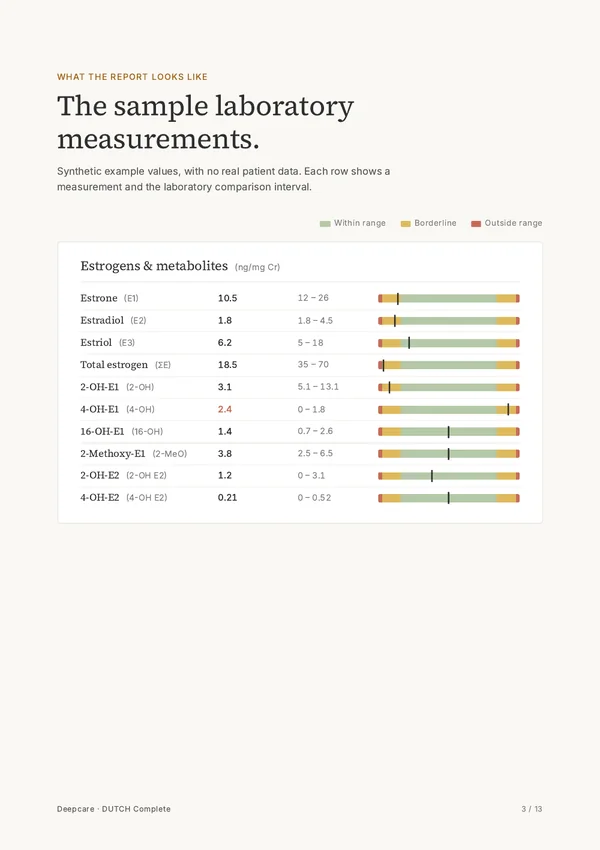
Section 01
Estrogens and their breakdown products.
Estrone, estradiol and estriol appear alongside the compounds formed as the body processes estrogens. Separate rows identify the 2-, 4- and 16-hydroxylation pathways and the methylated metabolite. [1]
Section 02
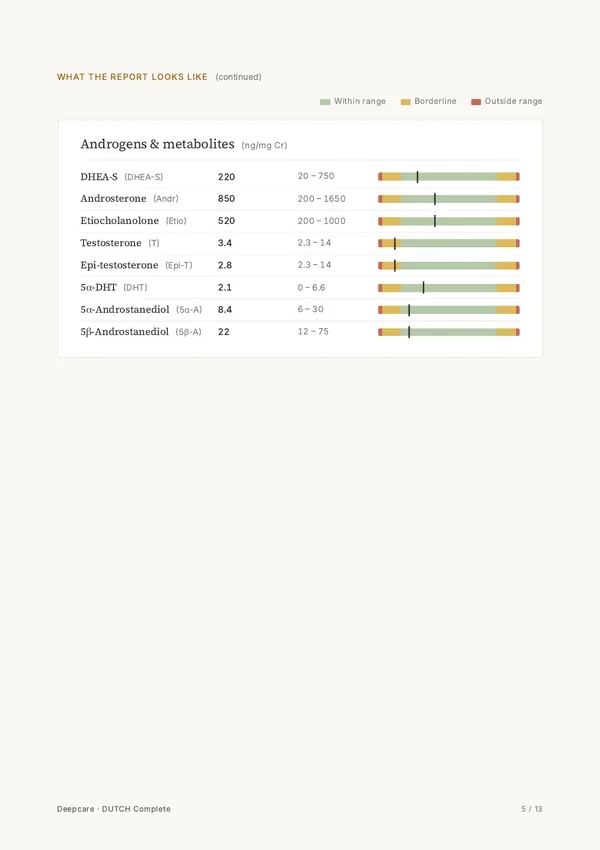
The androgen profile.
The report separates DHEA-S and the measured androgens from metabolites such as androsterone and etiocholanolone. These metabolites are products of steroid processing that leave the body in urine. [1]
Section 03
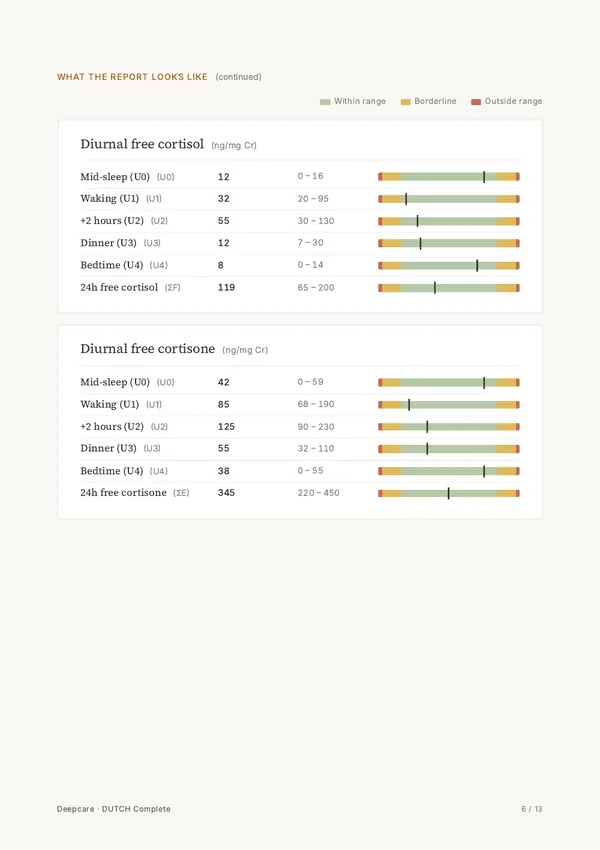
Cortisol across the collection day.
The timed samples give separate free cortisol and cortisone measurements. A further section lists their metabolites, so the time-specific results and the breakdown products can be read separately. [1]
Section 04
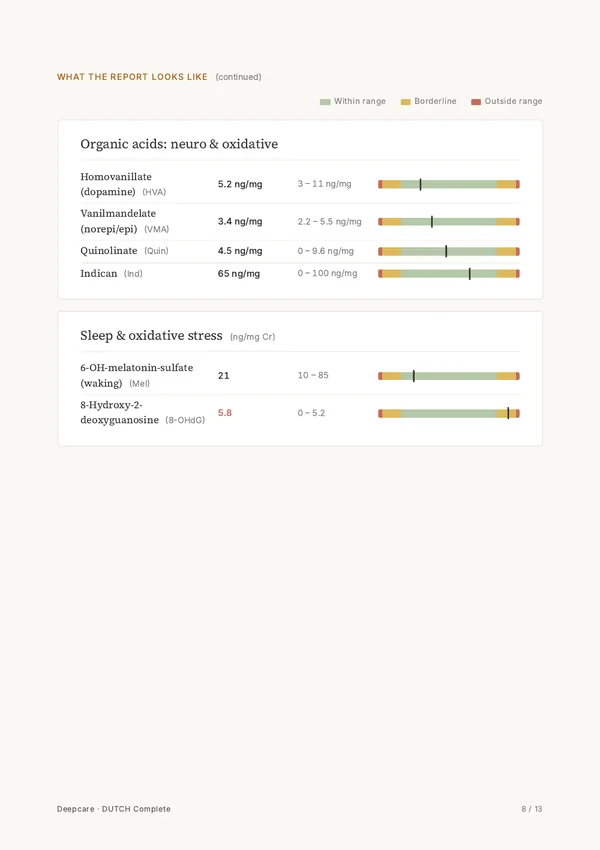
The organic-acid measurements.
The additional rows list individual organic acids and 8-OHdG, an oxidised DNA component measured in urine. Each retains its own unit and laboratory reference interval. [2]

Section 05
Your written Health Map report
The Health Map considers the laboratory results alongside your cycle information, everyday habits and other questionnaire answers. Follow-up questions arrive in writing when the analysis needs them.
The complete panel
What the laboratory measures.
Open a group to read each measurement. The groups follow the laboratory panel.
Estrogens & metabolites10
- Estrone (E1)
- Estrone is an estrogen made from androstenedione, a hormone precursor, and the body can convert it into estradiol. [1]
- Estradiol (E2)
- Estradiol is a potent estrogen made in the ovaries and other tissues through the conversion of androgen precursors. [1]
- Estriol (E3)
- Estriol becomes a major estrogen in pregnancy, when the placenta converts precursors supplied by the fetus. [1]
- Total estrogen
- Total estrogen combines the estrogen measurements specified in the laboratory's urinary panel into a single reported sum.
- 2-OH-E1
- 2-hydroxyestrone is a product of estrone breakdown, formed when the body adds an oxygen-and-hydrogen group at the position numbered 2 in the hormone molecule. [1]
- 4-OH-E1
- 4-hydroxyestrone forms during estrogen breakdown when an oxygen-and-hydrogen group is attached at position 4 of estrone. [1]
- 16-OH-E1
- 16-hydroxyestrone is made through a route of estrogen breakdown that adds an oxygen-and-hydrogen group at position 16 of estrone. [1]
- 2-Methoxy-E1
- 2-methoxyestrone forms when the body adds a small chemical unit called a methyl group to 2-hydroxyestrone, a step that helps inactivate this estrogen breakdown product. [1]
- 2-OH-E2
- 2-hydroxyestradiol forms as estradiol is broken down and can then receive a methyl group, a small chemical addition involved in inactivating this estrogen product. [1]
- 4-OH-E2
- 4-hydroxyestradiol is an estradiol breakdown product that the enzyme COMT, a protein that transfers small chemical units called methyl groups, helps inactivate. [1]
Estrogen metabolism ratios3
- 2-OH / 16-OH-E1 balance
- This ratio compares the measured 2-hydroxyestrone and 16-hydroxyestrone outputs in urine.
- 2-OH / 4-OH-E1 balance
- Dividing 2-hydroxyestrone by 4-hydroxyestrone gives the relative amounts of these two measured estrone metabolites.
- 2-Methoxy / 2-OH balance
- The 2-methoxy-to-2-hydroxy ratio compares the measured amounts of 2-methoxyestrone and the 2-hydroxyestrone from which it is made.
Progesterone metabolites2
Androgens & metabolites8
- DHEA-S
- DHEA-S is an abundant circulating steroid precursor produced mainly by the adrenal glands and available for conversion into sex steroids in other tissues. [1]
- Androsterone
- Androsterone is formed as the body breaks down testosterone and related hormones, before being processed for excretion in urine. [1]
- Etiocholanolone
- Etiocholanolone is a breakdown product of hormones such as testosterone that the liver attaches to a water-soluble molecule for urinary excretion. [1]
- Testosterone
- Testosterone sends hormonal signals by binding to proteins in cells called androgen receptors, and the body can also convert it into estradiol. [1]
- Epi-testosterone
- Epitestosterone has the same atoms as testosterone but a different three-dimensional arrangement at one position in the molecule. [3]
- 5α-DHT
- Dihydrotestosterone is made from testosterone and binds more strongly to androgen receptors, the proteins through which these hormones signal to cells. [1]
- 5α-Androstanediol
- 5-alpha-androstanediol is made when the body breaks down dihydrotestosterone, then attaches water-soluble groups to prepare it for excretion in urine. [1]
- 5β-Androstanediol
- 5-beta-androstanediol forms through a testosterone breakdown route that changes the shape of the hormone molecule before urinary excretion. [1]
Diurnal free cortisol6
- Mid-sleep
- Cortisol normally reaches its lowest circulating levels during the early night; this row reports free urinary cortisol collected during sleep. [4]
- Waking
- The rise in cortisol begins before habitual waking, and this sample records free cortisol in the urine collected on waking. [4]
- +2 hours
- Cortisol is usually higher in the morning than in the evening, and this collection samples the period 2 hours after waking. [4]
- Dinner
- Cortisol generally declines across the day, providing physiological context for the free urinary measurement collected around the evening meal. [4]
- Bedtime
- Bedtime urinary cortisol samples the late-day portion of a hormone rhythm that normally falls towards the night. [4]
- 24h total
- Only a small part of cortisol leaves the body unchanged in urine; most is first broken down and attached to water-soluble molecules for excretion. [1]
Diurnal free cortisone6
- Mid-sleep
- Cortisone is made when enzymes switch cortisol into an inactive form, and this sample measures the amount excreted in urine during sleep. [1]
- Waking
- The waking sample measures urinary cortisone, an inactive form of cortisol that the body can convert back into the active hormone. [1]
- +2 hours
- An enzyme can reactivate cortisone by converting it to cortisol; this sample measures cortisone excreted in urine 2 hours after waking. [1]
- Dinner
- The kidneys convert cortisol to inactive cortisone so it cannot overactivate the receptors that regulate salt retention; this sample measures urinary cortisone around the evening meal. [1]
- Bedtime
- The bedtime result measures cortisone, the inactive form of cortisol, leaving the body in urine at the final scheduled collection. [1]
- 24h total
- The daily cortisone total measures the amount excreted in urine without further breakdown, while the liver converts other cortisone molecules into tetrahydrocortisone. [1]
Cortisol metabolites & clearance5
- α-Tetrahydrocortisol
- Alpha-tetrahydrocortisol is a cortisol breakdown product with a different molecular shape from the beta form, produced as the body processes cortisol for excretion. [1]
- β-Tetrahydrocortisol
- Beta-tetrahydrocortisol forms through successive chemical changes to cortisol and is one of the hormone breakdown products excreted in urine. [1]
- β-Tetrahydrocortisone
- Beta-tetrahydrocortisone is a major urinary metabolite formed during the reduction of cortisone in the liver. [1]
- Metabolised cortisol
- Metabolised cortisol adds alpha-tetrahydrocortisol, beta-tetrahydrocortisol and beta-tetrahydrocortisone into the laboratory's combined metabolite result.
- Cortisol clearance rate
- This laboratory calculation compares the cortisol-metabolite sum with free cortisol and cortisone excretion.
Organic acids (OAT add-on)11
- Methylmalonate (B12)
- Methylmalonate is linked to a reaction that needs vitamin B12 to process propionate, a short-chain fatty acid. [5]
- Xanthurenate (B6)
- Xanthurenate forms during the breakdown of tryptophan, a building block of proteins, through an enzyme that needs vitamin B6 to work. [6]
- Kynurenate (B6)
- Kynurenate is made from kynurenine, a substance produced as the body breaks down the protein building block tryptophan, with help from vitamin-B6-dependent enzymes. [6]
- β-Hydroxyisovalerate (biotin)
- Beta-hydroxyisovalerate forms when the breakdown of leucine, a building block of proteins, takes an alternative route because a biotin-dependent enzyme is less active. [7]
- Pyroglutamate (glutathione)
- Pyroglutamate forms in the cycle that makes and breaks down glutathione, a substance that helps protect cells against damage from reactive oxygen compounds. [8]
- Homovanillate (HVA)
- Homovanillate is a major end product of dopamine breakdown that is excreted in urine. [9]
- Vanilmandelate (VMA)
- Vanilmandelate is an end product of noradrenaline and adrenaline metabolism, much of it formed in the liver before urinary excretion. [9]
- Quinolinate
- Quinolinate is a step in converting tryptophan, a building block of proteins, into NAD, a molecule cells use to release energy from food. [10][11]
- Indican
- Urinary indican is indoxyl sulfate, formed when the liver processes indole produced by gut bacteria from tryptophan. [12]
- 6-OH-melatonin-sulfate
- 6-sulfatoxymelatonin is the main urinary metabolite of melatonin and is used in research to follow its overnight secretion. [13]
- 8-OHdG
- 8-OHdG is an oxidised derivative of a DNA building block and is studied in urine as a marker of oxidative DNA damage. [2]
Scientific references
- Human steroid biosynthesis, metabolism and excretion are differentially reflected by serum and urine steroid metabolomes: A comprehensive review. Schiffer L, Barnard L, Baranowski ES, Gilligan LC, Taylor AE, Arlt W, Shackleton CHL, Storbeck KH., 2019. DOI: 10.1016/j.jsbmb.2019.105439. PMID: 31362062.
- Urinary 8-OHdG as a Biomarker for Oxidative Stress: A Systematic Literature Review and Meta-Analysis. Graille M, Wild P, Sauvain JJ, Hemmendinger M, Guseva Canu I, Hopf NB., 2020. DOI: 10.3390/ijms21113743. PMID: 32466448.
- Epitestosterone - MeSH. U.S. National Library of Medicine, accessed 2026.
- The Functional and Clinical Significance of the 24-Hour Rhythm of Circulating Glucocorticoids. Oster H, Challet E, Ott V, Arvat E, de Kloet ER, Dijk DJ, Lightman S, Vgontzas A, Van Cauter E., 2017. DOI: 10.1210/er.2015-1080. PMID: 27749086.
- Vitamin B12 - Health Professional Fact Sheet. NIH Office of Dietary Supplements, accessed 2026.
- Direct and Functional Biomarkers of Vitamin B6 Status. Ueland PM, Ulvik A, Rios-Avila L, Midttun Ø, Gregory JF., 2015. DOI: 10.1146/annurev-nutr-071714-034330. PMID: 25974692.
- Biotin. Perry CA, Butterick TA., 2024. DOI: 10.1016/j.advnut.2024.100251. PMID: 38825069.
- Glutathione Metabolism. Yudkoff M, 1999.
- Biochemical Diagnosis of Catecholamine-Producing Tumors of Childhood: Neuroblastoma, Pheochromocytoma and Paraganglioma. Eisenhofer G, Peitzsch M, Bechmann N, Huebner A., 2022. DOI: 10.3389/fendo.2022.901760. PMID: 35957826.
- Kynurenine Pathway of Tryptophan Metabolism: Regulatory and Functional Aspects. Badawy AA., 2017. DOI: 10.1177/1178646917691938. PMID: 28469468.
- Niacin - Health Professional Fact Sheet. NIH Office of Dietary Supplements., accessed 2026.
- Indoxyl sulphate and kidney disease: Causes, consequences and interventions. Ellis RJ, Small DM, Vesey DA, Johnson DW, Francis R, Vitetta L, Gobe GC, Morais C., 2016. DOI: 10.1111/nep.12580. PMID: 26239363.
- Measuring melatonin in humans. Benloucif S, Burgess HJ, Klerman EB, Lewy AJ, Middleton B, Murphy PJ, Parry BL, Revell VL., 2008. DOI: 10.5664/jcsm.27083. PMID: 18350967.
Included in the price
Your kit and your written Health Map.
Delivery to Switzerland, Liechtenstein and every EU country in 2 to 3 working days. Sample return is included.
The kit arrives in the laboratory's packaging. Product pictures are illustrations.
CHF 399
Price includes delivery, prepaid sample return to the laboratory, laboratory analysis and your written Health Map report.
Pay by card or TWINT
With this kit, add GI MAP Usual price: CHF 399 Combo price: CHF 349.
Your written Health Map report
The kit price includes a systematic written evaluation for each person tested. We consider all of that person's kit results together with their questionnaire answers and any other results they share. After payment, your first personalised questionnaire arrives by email. Your answers, laboratory results and email exchanges form the basis of the report. Follow-up questions arrive by email or a further questionnaire when needed. The final report is written in your language, English, French or German, within 3 working days of your answers to the last questionnaire.
Read about the Health Map ↗Questions about this kit
When do I collect the samples?
Follow the times and cycle-day instructions supplied with your kit. Record the collection times on the form.
How does this differ from Cycle Mapping?
DUTCH Complete uses a collection day. The combined Cycle Mapping kit adds repeated collections across the menstrual cycle for estrone, estradiol and progesterone metabolites.